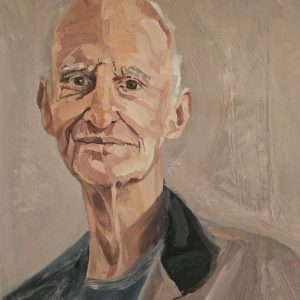
ARTIST: Ruth Leigh
TITLE: Arnold Carter
DESCRIPTION: Don’t you ever give up work… your mind will tell you about it. Your body will tell you about it—but don’t ever let the mind override the body. Born in 1926 in Cottesloe, Perth, Arnold Carter’s life traces the early development of Western Australia’s northwest—through mining, local government, and community life.
Arnold’s belief in progress guided his decision making through his life- whether navigating setbacks early in his career or helping shape Port Hedland’s growth.
Arriving in the Pilbara in the early 1960s, Arnold witnessed- and helped shape- the transformation of the region from a small coastal outpost into one of the world’s most significant iron ore ports. Arnold recalled with pride a time when Port Hedland was defined by families, shared responsibility and local connection. At the same time, his enduring commitment to work, learning and contribution remained central to his life, and was especially evident in his long-standing involvement with the Hedland Historical Society. Arnold passed away in August 2025. Through to his last dayshe continued to volunteer, research, present, and advocate for the preservation of local history.
I was born in Perth in Cottesloe. That was 1926. Yeah. I went to Subiaco High School. I studied at the college. I educated at the tech school. And then why I got really motivated to get moving was that I used to work for the State Electricity Commission, which is now Horizon Power. And I used to make applications for these jobs and I used to get the jobs quite easily, but in those days it wasn’t ability. It was time. If you were working for somebody two days longer than when the application went in, you were out. It never went on ability.
So I got three or four jobs for them and each time I lost it through appeal… That happened to me three times. So I said, “Well, that’s the finish of that. I’m not going to stay here any longer.” But I’d done my qualifications on accounting, so it didn’t worry me… I went into mining and that’s how I stuck into mining.
Well, it’s really, really by mistake that I got to Port Hedland. In 1960, I was in Perth and I ran into some gentlemen who were mixed up in iron ore… one of them happened to be… the top brass of Hammersley Iron, and he says, “You really want to go up?” And I says, “Yes, I really want to go up.” I got in this little plane… all the way up to Boolgeeda- it was the campsite for a drilling rig… they were just drilling to find out how much iron ore they had. What they were doing up there, they were just drilling. They weren’t mining iron ore. They hadn’t even taken the leases of it at that stage because there was an embargo on the sale of iron also. Nobody could sell it. … When I walked out and saw Goldsworthy, I thought, “What a huge deposit.”
Everything in mining starts from the accounts. First of all, you’ve got to find out how much iron ore you’ve got. Then you’ve got to find out what is the quantity of the iron ore. Thirdly, you’ve got to find out somebody to buy it. And fourthly, you got to find out when is it available to be sold because you’ve got to pre-empt and spend millions and millions of dollars of putting everything together before you can even produce it. We didn’t even have a wheelbarrow when we started… but it took us two and a half years to put the railway line in… and negotiate selling iron ore to Japan. Japan was the only person in the iron ore industry. China didn’t exist [in the market then]. All this was part of this two and a half years of what I was doing to enable the possibility of Goldsworthy Mining, which was the first iron ore business come outside to commence business. And that was basically the story how I got here.
I arrived in Port Hedland February the 23rd, 1962. There was 1100 people here. No industry at all, nothing. I’ve lived here since 1962… the same house, Moore Street. When we first started, we had everybody that was working here had jobs. Even the kiddies had jobs doing things, there was a whole family unit. I think in 1972, 73, we had 20,000 people. It had blown up from 1,000 to 20,000 within 10 years. But then the rots set in. Fly-in, Fly-outs, and as soon as Fly-in Fly-outs come in, that was the end of the Port Hedland. And at the present moment, the richest port in the world for the establishment of iron ore, 14,000 people is our population. Of that 60% is flying fly-out. What’s your growth? We’ve got nothing here.
I spent 38 years in local government. I was seven years a Shire president. So my hobby always has been local government. I still get it [the Shire agendas] I still read every one of them. When I was Shire president. I used to have a lot of interviews for people coming and visitors and things like that. And I used to wake up in the morning and say, “Oh geez… I’m not going to enjoy this very much.” But then I’d get up, I’d go up there and I’d sit down and within an hour, my whole mind was with the person concerned, who I was talking to and I’m taking it all on board so that once he leaves, I’ve got it either written down or I’ve got a notation written down, where your reference is that you have gained something out of that discussion.
Staying home [now], I could not stay at home for seven days a week. My wife’s 96, and she got the OAM through her services to the medical profession. I said to her, “Well, I’m going to do a deal with you. ” She says, “What’s that? ” I says, “I am still working. I could not stay home all the time.” And she says, “No, I agree with that. ” So she said, “Okay.” I said, “What I’ll do is that I will stay here [working at Dalgety House Museum] every day until midday.” I said, “By that time midday, you would have gone for your breakfast your morning. Silver Chain would have come in and they would have done everything they would have. And you would have had your lunch.” I said, “And then you could make me some lunch, put it in my thing and I’ll come down and I have my lunch down here. And that’s what’s worked out well. She has her own privacy. She has her own personality, what she wants to do. She’s a lovely lady- Francis. Yeah. Lovely lady. And she’s just had her 93, no, 96. She’s had her 96th birthday.
I can remember going back 30 years when I had a triple bypass, and the doc said to me, he says, “Hey Arnold, I want to talk to you. ” And I says, “Yeah, what is it doc?” He says, “Are you going to go back to Port Hedland?” I says, “Sure am.” He says, “Well, let me give you some advice.” He said, “Don’t you ever give up work.” He says, “Your mind will tell you about it. Body will tell you about it. ” He says “But don’t ever let the mind override the body every time.”
I’m working now. I’m doing this on a voluntary basis. I’ve been working for the Hedland Historical Society for 22 years. Everything that happens in here, [at Dalgety House] it’s just donated. We’ve got big displays up there- mainly pastoral industry… There’s no history in the future. It’s changed before you get there.
[Points to photograph behind Arnold of a building being craned into place] The story behind the photo is that it was actually the quarters for the Dalgety House staff…. which is now the museum. And they come up and they said, “We’ll get rid of this. We’ll throw this away.” And I says, “You’ll what? ” He says, “You’ll throw it away.” I says, “No, you won’t.” I said, “I want that. ” And they said, “What the hell are you going to do with that? ” And I says, “I’m going to use it as a display for [the Historical Society], you see?” And they said, “Well, how are you going to get that? ” I said, “Leave it to me. ”
And believe it, after a lot of negotiations and a lot of discussions, I eventually got a local crane business and I said, “Can you transfer that from there to there?” And he says, “Arnold, that’s going to be a hell of a job.” I says, “I know that. ” I said, “But can you do it? ” He says, “Yes.” He says, “How much are you going to pay?” And I says, “Nothing.” And he says, “Nothing?!” And I says, “Yeah.” I says, “It’s going to go to the tip. They don’t want it. And it’s the oldest house in Port Hedland, because look at the size of the roof. It’s over a hundred years old.” And I says, “It can’t go to the tip.” He says, “Well, all right.” He said, “We’ll do a deal. If you can get somebody to supply the stumps and have them all erected where you want to put your sheds, I will arrange for the cranes to come down and switch it over”…
They were all big overhead cranes that they used for the trains and things like that. And they just swung them around, beautifully done. I was here, watched them do it… believe me it was a wonderful thing to see the preciseness of those crane drivers and the huge cranes up in the air, and they bought it over and after about an hour and a half, they said drop. And by drop, they just dropped it onto the stumps and it fitted perfectly. You wouldn’t believe it.
MEDIUM: Oil on Linen
$970.00
In stock